Never give Hafiz to a man looking for a Barbie
As a Licensed Marriage and Family Therapist (LMFT) and founder of The Psychology Projects, I've spent years studying how ancient symbolic systems function as psychological tools — and few examples are more precise than the work of Hafez, the 14th-century Persian poet widely regarded as the greatest lyric poet in Persian literature. This article explores how Hafez used poetry not as decoration, but as a clinical-grade mirror: a structured mechanism for bypassing ego defenses and surfacing unconscious material. Drawing on Persian cultural tradition, Sufi mysticism, and the symbolic function of the Faal-e Hafez ritual, I examine why this 700-year-old diagnostic tool continues to outperform standard therapeutic language — and what it reveals about the psychology of self-reflection in modern culture.
We live in a world obsessed with "healing," yet most people choose mirrors that protect their ego rather than reveal it.
Human beings grow through reflection, understanding, and empathy. We understand ourselves through the symbols, stories, and cultures we attach to. Empathy is the art of human compassion. Everything around us acts as a mirror, reflecting pieces of our psyche, our wounds, and our identity.
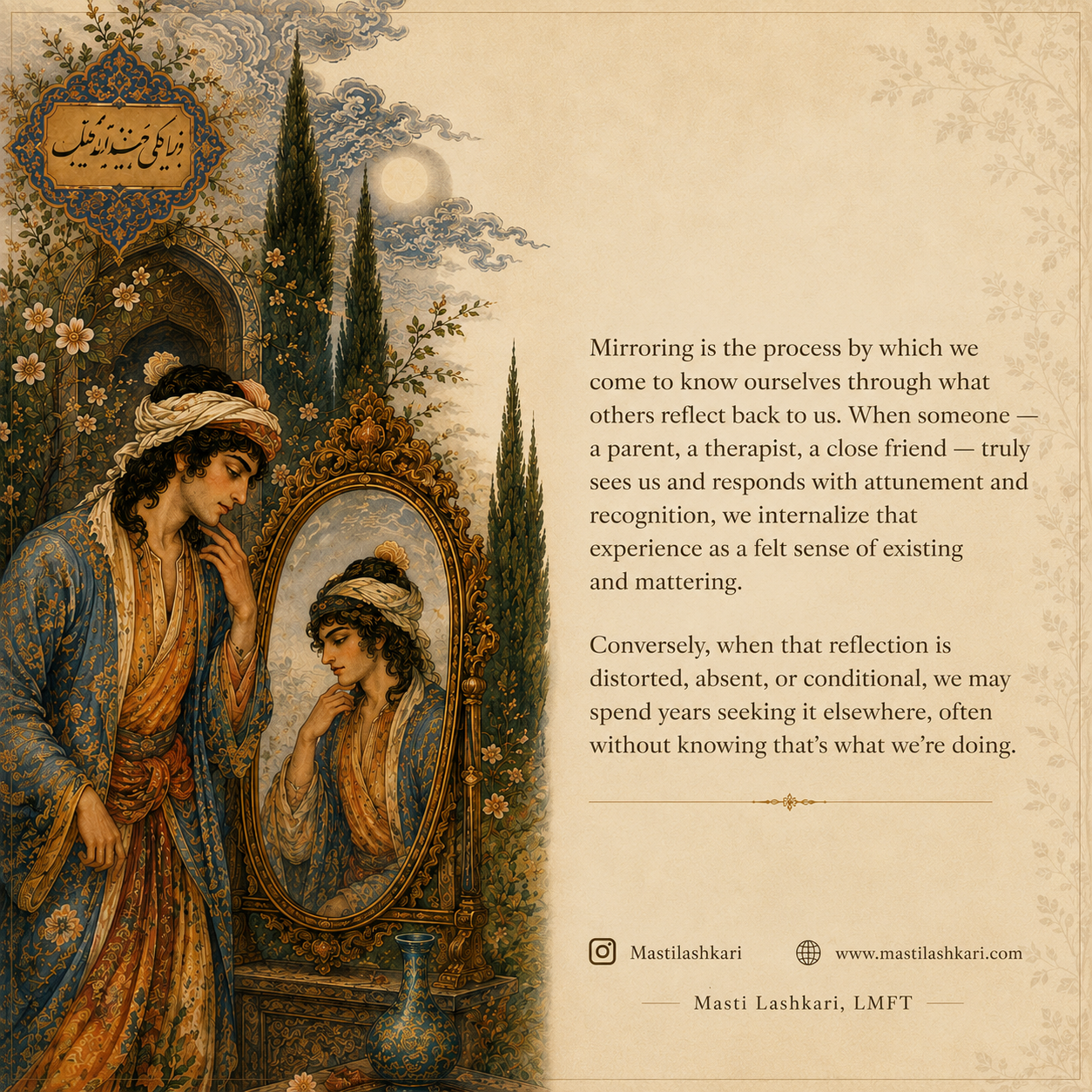
But Not All Mirrors Tell the Truth
Some mirrors are manufactured to comfort the ego, not confront the psyche. They are designed to make us feel more "wanted" or "valuable" through a lens of artificial perfection.
The danger is in the exposure. After enough time spent with artificial mirrors, the authentic ones begin to feel threatening. Truth starts to feel offensive.
A real mirror no longer feels beautiful because the nervous system has been trained to prefer plastic.
For over 1,300 years, the Persian culture has been locked in a silent, tectonic struggle. It is the battle between being Muslim and being Persian—and I want to be clear: this isn’t an insult to Islam. Islam is a beautiful, powerful, energetic theology that I respect deeply. But the Persian culture is our root. It is who we were before.
The poets kept the essence of Persia alive, even as empires, war, and ideology repeatedly sought to erase it. The poets became the underground nervous system of Persian identity.
Scholars and poets such as Rumi, Ferdowsi, Saddi, and the one we call Hafez preserved the psychological architecture of Persian culture through poetry and symbolism. But people, even some of us Persians, don't truly understand how they saved us. They think it’s just pretty words. They don’t realize it was psychology encoded into symbolism. It was a 700-year-old psychological survival tactic.
The Guardian of the Shadow
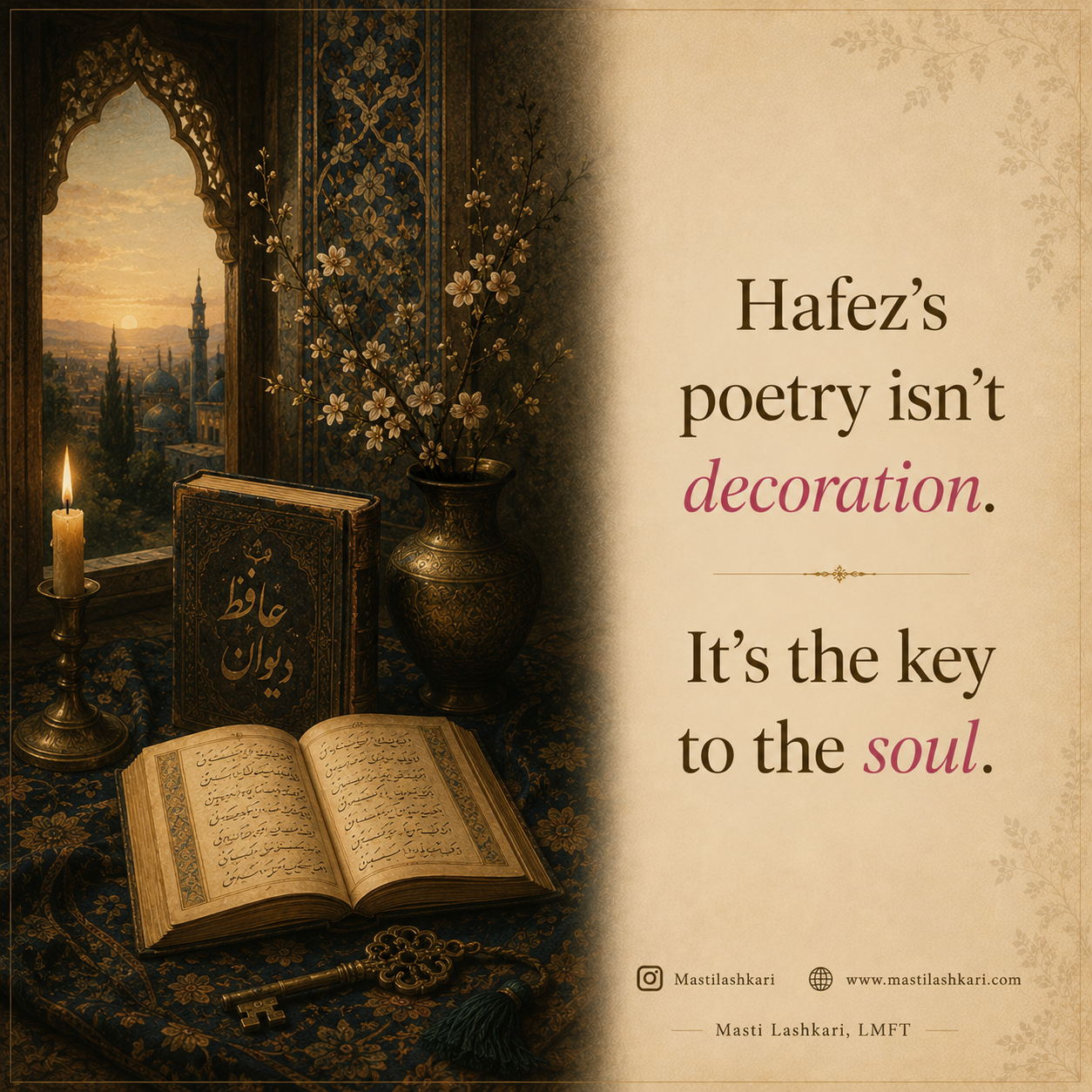
The name Hafez is actually a title — one earned by memorizing the entire Quran. It comes from the Arabic root meaning "guardian" or "preserver," given to those who safeguard the holy text through memory. By taking it as his pen name, Hafez was doing something quietly audacious: he was announcing his religious credentials while using them as a license to dismantle religious authority from the inside.
His poetry is relentless in targeting clerical hypocrisy — the preachers, the judges, the moral enforcers who preached virtue while practicing the opposite. He even drops his own pen name into lists of fraudulent holy men, as if to say: I know what I am, and I know what you are. The title didn't protect him cleanly — religious authorities eventually refused to bury him in a Muslim cemetery — but it gave his critique a razor's edge that a secular poet never could have had. Only someone who had memorized every word of the Quran could call out its self-appointed guardians with that kind of authority.
This is what people misunderstand about Hafez: his poetry isn’t decoration. It’s a key.
And this is the thing people don't understand about Hafez — his poetry isn't decoration. It's a key. One line. Just one line, and you could sit with it for hours and keep finding something new every time you come back to it. People call it fortune telling, and I get why — in Iran, people still open their Divan when they need answers. But that's not what's happening. What's happening is you set an intention, you read it, and it holds up a mirror. You see yourself. That's not magic. That's psychology. Hafez knew that the right words don't give you new information — they bring up what's already inside you that you didn't have the language for yet.
This is psychology, not magic.
Hafez bypasses the ego and forces the unconscious to speak. It’s a 700-year-old diagnostic tool for the soul.
The Longest Night: Honoring the Return of the Light
This is why Yalda—the winter solstice—is so vital. It’s a 4,000-year-old tradition rooted in the Zoroastrian faith that people consistently misunderstand. The ancient Persians never "praised fire"; they respected the four elements as the foundations of life. Their holidays were precisely calibrated to the seasons because they understood that the cycles of nature are the ultimate mirror for our internal state.
Winter is the season of the interior. As the days shorten and the world grows cold, the nervous system is forced to look within. Yalda is the "Night of Birth"—the longest, darkest night of the year—and it serves as a symbol of the struggle between darkness and light.
But you don't fight the darkness by running from it. You fight it with life. We stay awake through the shadows, dancing, laughing, and eating the vibrant red fruits—pomegranate and watermelon—that represent the glow of the sun and the spark of life.
The heart of the night, however, is the Faal-e Hafez. Every person sets a deep, private intention, and a book of Hafez is opened. This is where the community becomes the mirror. Friends and family gather around to help translate the meaning of the poetry, helping you find the light within your own darkness. It is a collective ritual of "uncloaking" the unconscious. You aren't just reading a poem; you are having your soul interpreted by those who love you, using 700-year-old words to find a way forward into the dawn.
Beyond Talk Therapy: The Poetry of the Unconscious
This isn't just theory; I’ve seen it disrupt the most analytical minds.
On the last winter solstice, I sent a poem by Hafez to every one of my clients. The response was immediate. Conversations shifted. Defenses softened. People began articulating emotions they had intellectually avoided for years. We opened doors that standard therapy lines—the usual clinical "how does that make you feel"—could never reach.
My writers found their blocks dissolving, but it went even deeper with my more technical, "studious" clients, like the engineers. Why? Because these are the people who, since childhood, have used books as their map for the world. They are wired to find truth in the written word.
By tying an ancient, symbolic poem to a modern intention, we bypassed the ego entirely. It went straight to the nervous system. When you read a line that was written 700 years ago—yet describes your current internal battle with surgical precision—it destabilizes the illusion that your internal world is random or isolated.
It proves that we are inherently connected to symbolism. We aren't just looking for "information"; we are looking for a reflection that is deep enough to hold the weight of our truth. Standard clinical language is a flashlight, but this poetry is a floodlight. It reveals the pieces of the self that both the client and the therapist might have missed.
The Mirror vs. The Plastic
But here is the problem. We are trying to give this depth to a world that is being wired for the superficial.
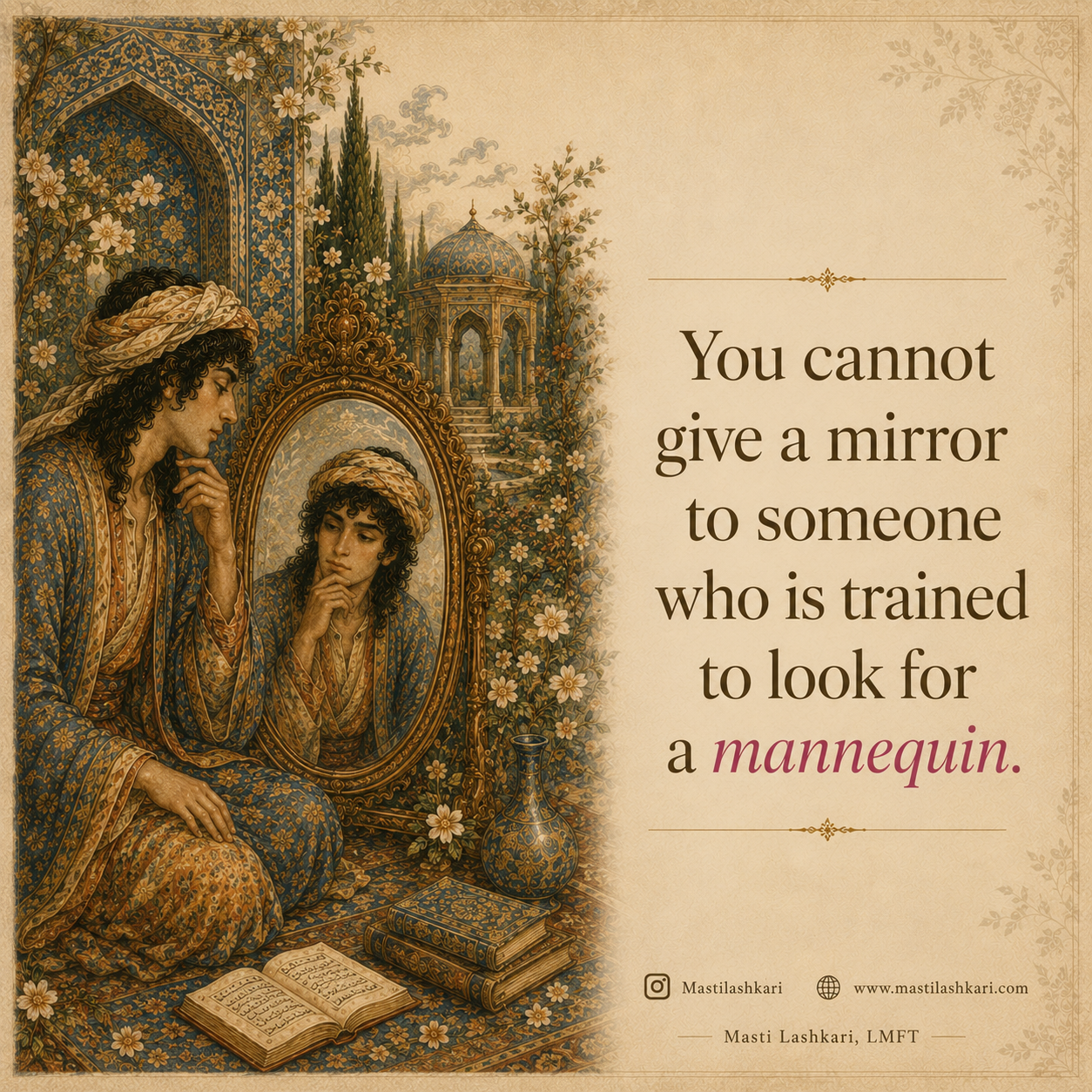
Modern culture raises people on artificial mirrors. A doll that is fake. Everything about her figure—the legs, the hair, the nose—is a lie. It messes with the mind because it gives you a "mirror" that doesn't actually exist in nature. In other words, a manufactured figure built on artificial proportions and performative perfection.
When you open a book of Hafez, especially the old versions with the drawings, you see real bodies. You see love, you see lust, you see graphics that are raw and fascinating. You see humanity in all its messy, beautiful, deep layers.
You cannot give a mirror to someone who is trained to look for a mannequin. If you are going to give someone culture, if you are going to give them a tool to see their "Highest Self," you have to make sure they aren't wired to search for a Barbie. One is a gift of high value that demands you look at your soul; the other is just plastic that asks you to stay on the surface.
If you want depth, you have to be willing to sit in the solstice's dark and wait for the light. You have to be willing to see yourself—not as a doll, but as a poem.
Never give Hafez to a man who is looking for a Barbie.
He won't know what to do with the truth.
Masti Lashkari, LMFT, is a Licensed Marriage and Family Therapist and the founder of The Psychology Projects. With a clinical background in analytical psychology, nervous system regulation, and cultural trauma, Masti works at the intersection of depth psychology and lived human experience. Her writing explores how ancient symbolic systems, mythology, and cross-cultural wisdom function as psychological tools for modern self-understanding. She is based in California and works with high-achieving individuals navigating identity, culture, and transformation.